Needs assessment reaffirms Steamboat Springs housing crisis
Sixty percent of renters considered low-income

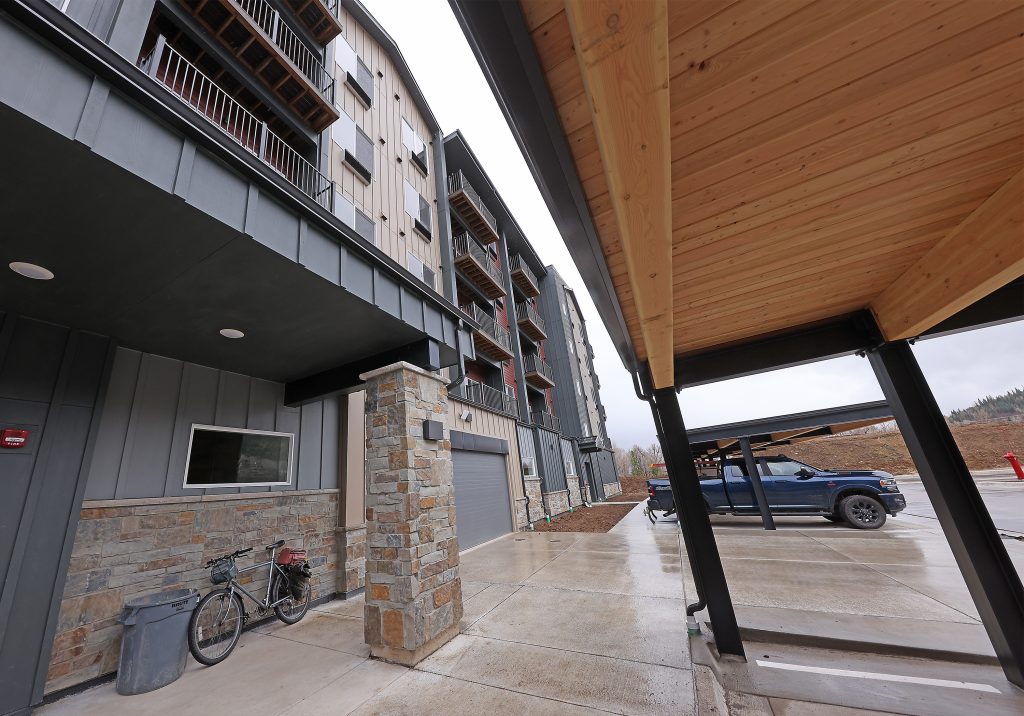
John F. Russell/Steamboat Pilot & Today
The Steamboat Springs City Council was presented with a housing needs assessment last week, reaffirming a well-known truth in the city: Local housing need overwhelmingly outpaces the available pathways to meet it, and that the disconnect between wages and cost of living is exacerbating a problem that has grown increasingly dire since the COVID-19 pandemic.
The study is the result of a state mandate passed in 2024 that requires most local governments throughout Colorado to publish a housing needs assessment by Dec. 31, 2026 and update it every six years thereafter, Principal Planner Brad Calvert told councilors.
Presented at council’s June 9 work session by Brian Duffany and Karlyn Russell-Carlson of Denver-based consulting firm Economic and Planning Systems — the same firm that helped conduct last summer’s Yampa Valley Housing Authority-commissioned housing demand study — the assessment serves not as a binding document, but as an informational tool for both local governments and state agencies to use for planning and grant funding purposes.
Much of the data presented in last year’s study remained largely consistent in the recent assessment.
The region is still shifting toward an older, wealthier, more part-time population, with unearned income holding firm as the fastest-growing income source. Over half of the rental population remains cost-burdened, meaning they are paying more than one-third of their income for housing.
“In 2025, the median home price was $1.3 million. That is a lot of money,” explained Russell-Carlson. “The typical two-person household earning that median household income of $106,000 per year can afford a $390,000 home. So you’re looking at a gap of about $900,000.”
“That is absolutely enormous, and that’s a big reason that’s driving a lot of the housing needs that we’re seeing,” she continued, adding that across the market as a whole, 70% of home sales are over 200% of area median income. “That leaves very little inventory elsewhere on the housing spectrum.”
Russell-Carlson said that housing needs are being observed across the entire AMI range, not just at the lower levels.
What matters in your community, delivered daily.
Sign up at SteamboatPilot.com/newsletters
Steamboat has roughly 1,200 units of what the state deems “regulated housing,” with a third composed of YVHA units, a third of employer-provided units, and the final third encompassing units with workforce restrictions.
Taking unoccupied units out of the picture, this means that around 20% of all households in Steamboat Springs are living in regulated units, said Russell-Carlson.
“We were pretty impressed by that (statistic) …. you guys have made a lot of progress in the last 10, 15 years,” said Duffany.
Sixty percent of renters are low-income — defined as making less than 80% AMI, or roughly $90,000 for a two-person household — and over 40% have moved unwillingly in the last five years due to a range of displacement factors, such as rent increases, eviction and landlords converting properties to vacation rentals.
Over a third of renters are considered “extremely cost-burdened,” meaning they are paying over half of their income for housing.
Duffany explained that Steamboat needs 1,573 units for the town to “catch up” with demand, and approximately 767 units for it to “keep up” with projected demand over the next decade, for a total of 2,340 additional units, or around 230 units added per year. Most critical would be additional housing for the 50-80% AMI segment of the population, which he called the “core workforce.”
“We really, really encourage people not to focus on the total numbers, but to look at the patterns,” said Duffany. “It’s tricky here because the housing needs … we’ve really found that they’re all over the spectrum.”
The consultants then presented their recommendations: that the city deploy its short-term rental tax funds to develop a range of housing units; that YVHA’s mill tax levy, currently set to expire in 2027, be extended; that the city consider other financial incentives for development; and that they preserve affordable housing with deed restrictions.
The city approved a $3 million pilot deed restriction program funded by STR tax revenue in the spring. As of this week, the pre-screening form for the program, dubbed Home Base Steamboat, is open, the city announced Tuesday.
Duffany and Russell-Carlson also recommended the city place affordability guarantees on new regulated housing and track development progress, as well as expanding existing programs to reach residents vulnerable to displacement.
Council President Steve Muntean questioned whether the combination of “catch-up” units and new units potentially added over the next decade would be sufficient to house both employees currently here and new employees coming to Steamboat down the road. “What percentage of those units would go to those people who are cost-burdened now?” he asked. “Because it would seem to me that we could end up with a situation where we couldn’t bring any new employees into town …”
Duffany admitted the data is vague and that no community can realistically build enough housing to consistently meet its affordable housing needs.
“I would just encourage this community to sort of think about, like, do we want to more formally think about how we do housing-related planning at the regional scale between now and … six years from now?” said Calvert at the close of the discussion. “And I really think that is for elected leaders and community leaders to arrive at.”









Support Local Journalism
Support Local Journalism
Readers around Steamboat and Routt County make the Steamboat Pilot & Today’s work possible. Your financial contribution supports our efforts to deliver quality, locally relevant journalism.
Now more than ever, your support is critical to help us keep our community informed about the evolving coronavirus pandemic and the impact it is having locally. Every contribution, however large or small, will make a difference.
Each donation will be used exclusively for the development and creation of increased news coverage.